
Chart Forensics
I Spent an Evening Staring At Data So You Didn't Have To


I’ve always loved the science behind music. Songs are full of patterns, signals and small details that change how people respond to them.
Now thanks to AI I don’t have to spend weeks learning new data systems. So one lazy Sunday morning a couple of weeks ago I decided to dissect some UK chart data.
I pulled apart the top 1,047 streaming songs from the last 16 months (January 2025 to April 2026) and looked at them from a bunch of different angles to get a closer look at the anatomy of what songs worked and why. This started as a massive article but I didn’t wanna bore you too much so I’ve selected some of the more interesting points.
A quick caveat before you dive in: while the full dataset covers 1,047 songs, some of the findings come from smaller subcategories where a couple of outliers can skew the picture. I’ve kept those in where the data still feels interesting, but the findings backed by hundreds of songs are the ones I’d trust most.
None of this is a formula for making a hit and like all data, it should be treated with a degree of caution. Some of it backed up instincts I already had, some of it genuinely surprised me - all of it made me more curious.
All comments and contradictions welcome! enjoy
Title Word Count
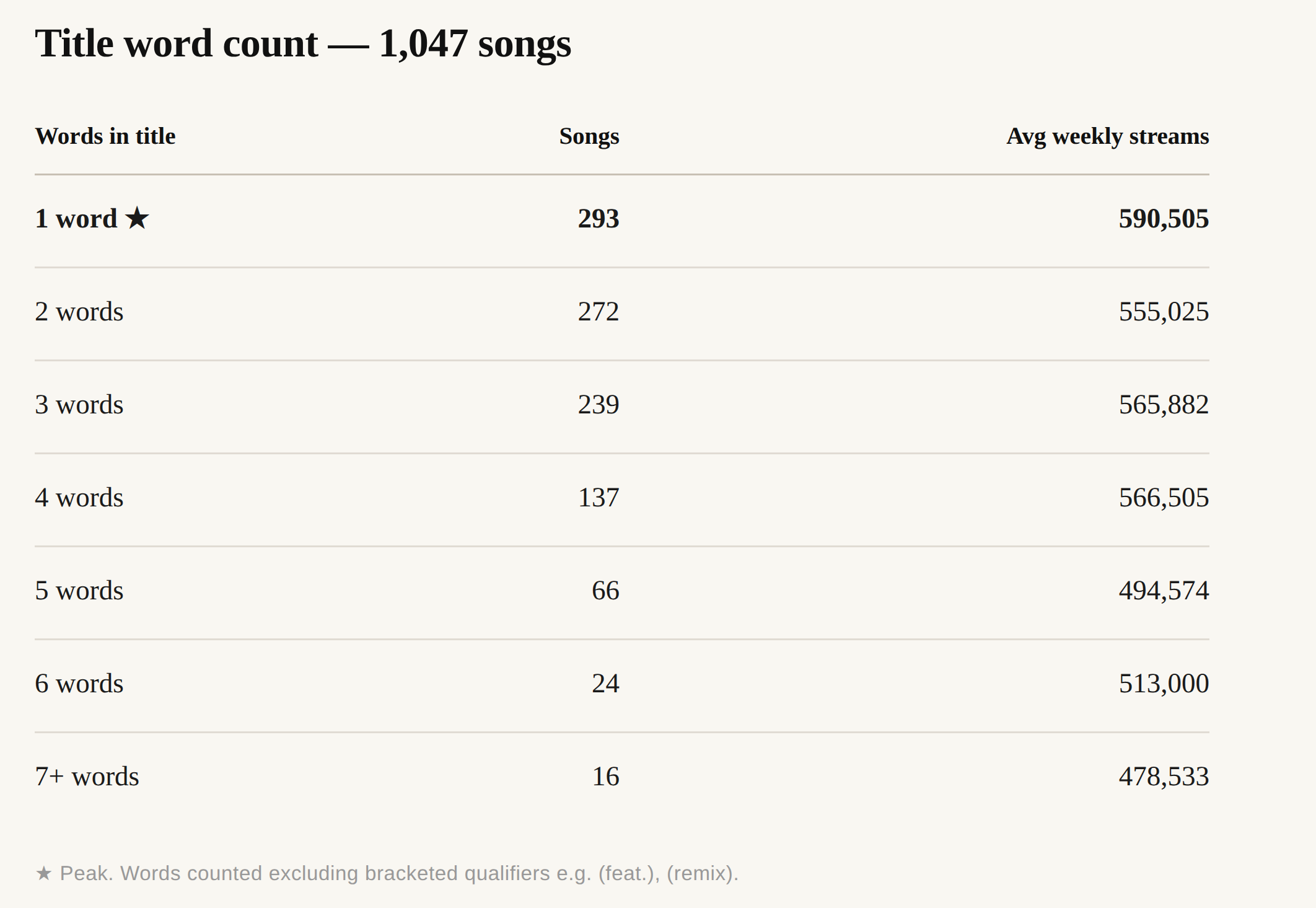
One word titles average ~590k weekly streams and is also the most common title format. Whether shorter titles perform better because they're easier to find, easier to remember or something else is an open question.
Title Opener
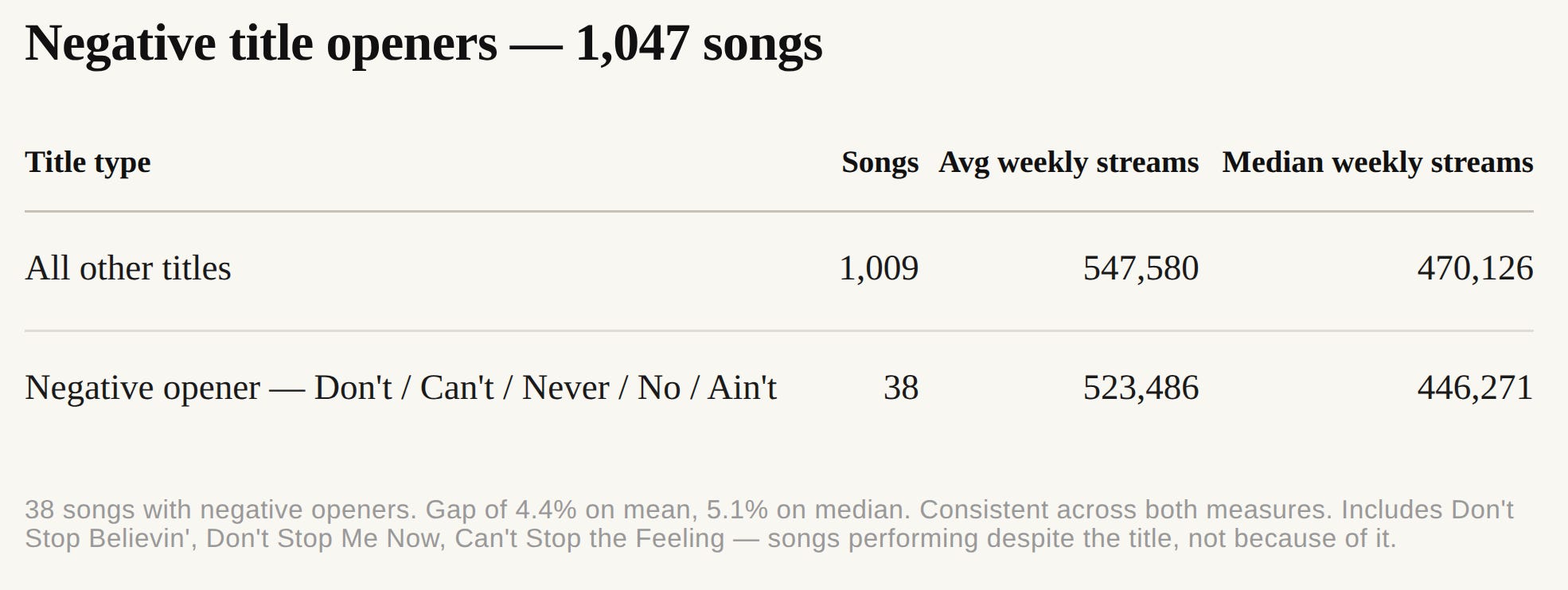
38 songs open with Don't, Can't, Never, No, or Ain't and they average about 4.4% fewer streams than everything else. What's interesting is some of the songs on the list:
Don’t Stop Believin’ - Journey
Don’t Stop Me Now - Queen
Don’t Look Back in Anger - Oasis
Can’t Stop the Feeling! - Justin Timberlake
These are some of the most iconic titles ever written and they’re in the lower performing category. Which raises the question - would they stream a few percent higher with a different first word?
Apostrophes In Title
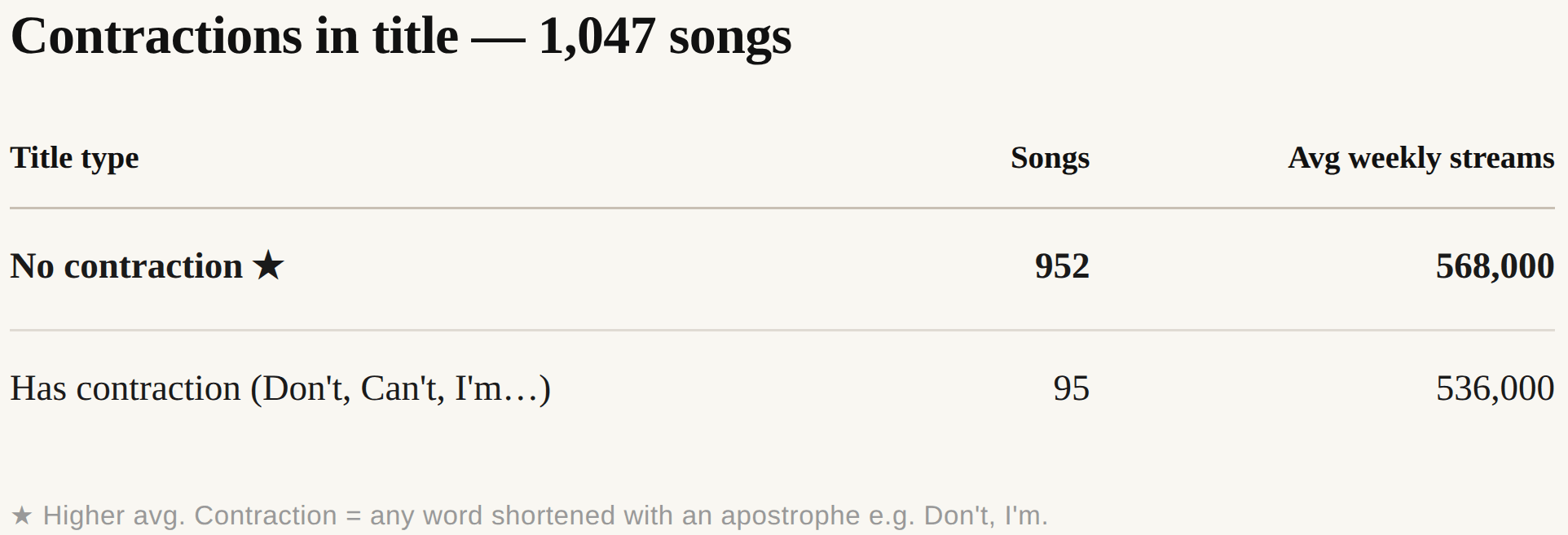
Titles with apostrophes average 5.6% fewer weekly streams than clean titles. The obvious theory is search inconsistency: DSPs don’t always handle apostrophes cleanly in search and listeners type them in different ways. Whether that fully explains the gap is less clear, but the pattern is worth noting.
Lyric Word Count
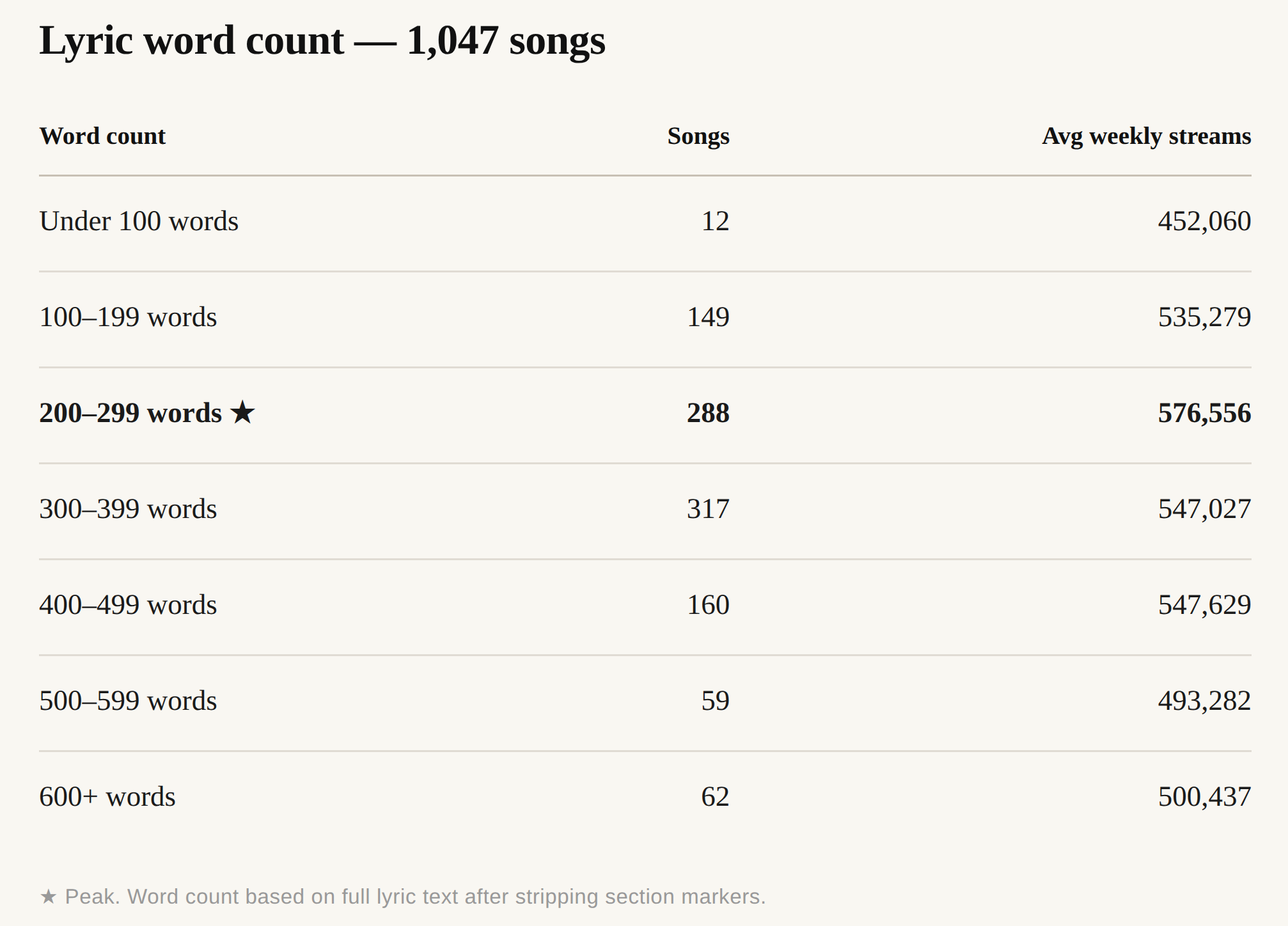
200 to 299 words appears to be the sweet spot and its also where most songs fall. Whether that word count helps drive streams or simply reflects the kind of songs that tend to perform well is hard to say. The under 100 group is only 12 songs so don't read too much into that end of the table.
Most Common Words
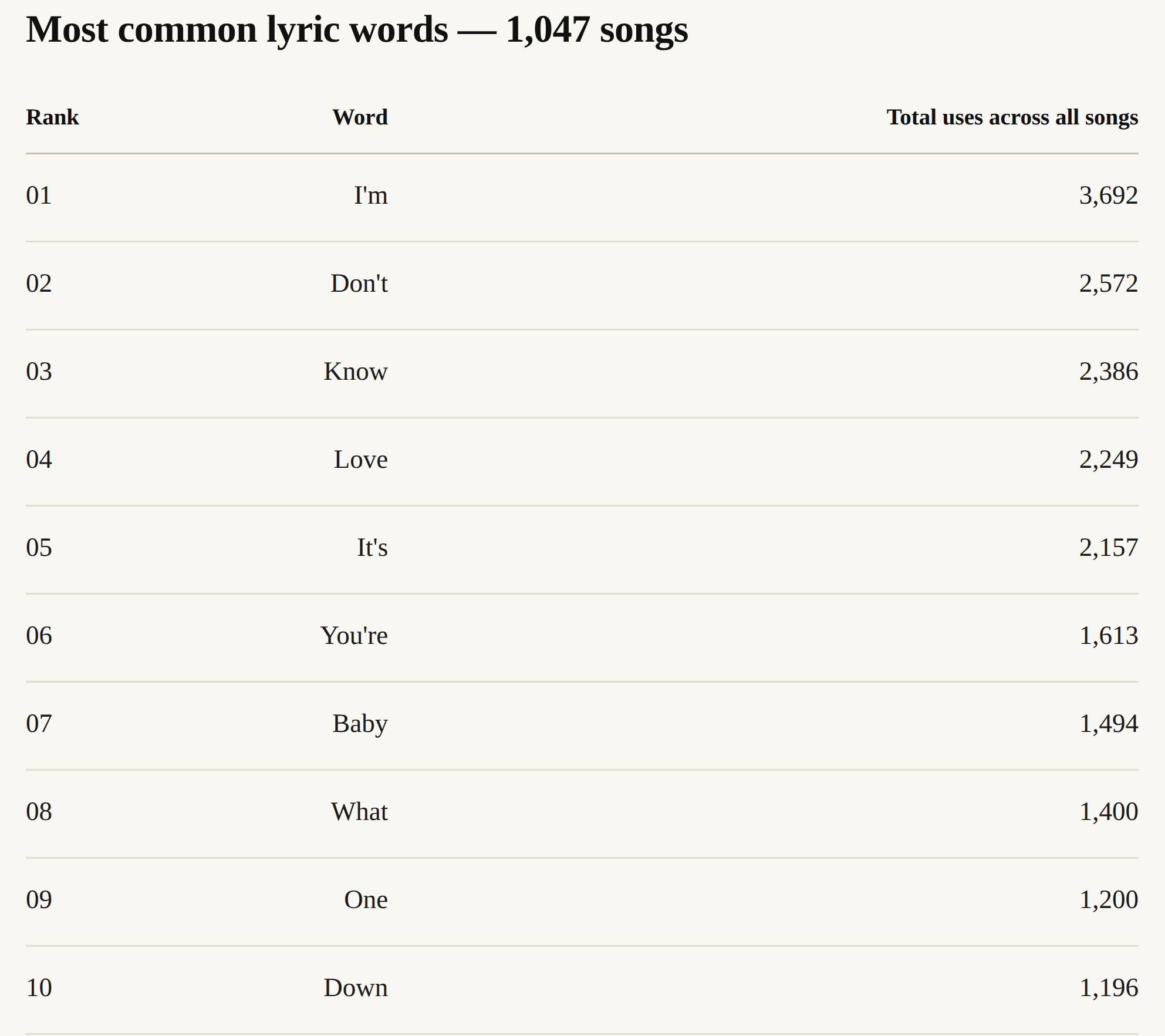
The most used word across all 1,047 songs is I'm with 3,692 mentions. Know ranks above Love. Don't (a negative) sits second overall, above every word of desire or connection in the dataset. Baby still clocks 1,494 uses so pop hasn't abandoned its conventions. But the shape of the language is curious…
Dominant Tense
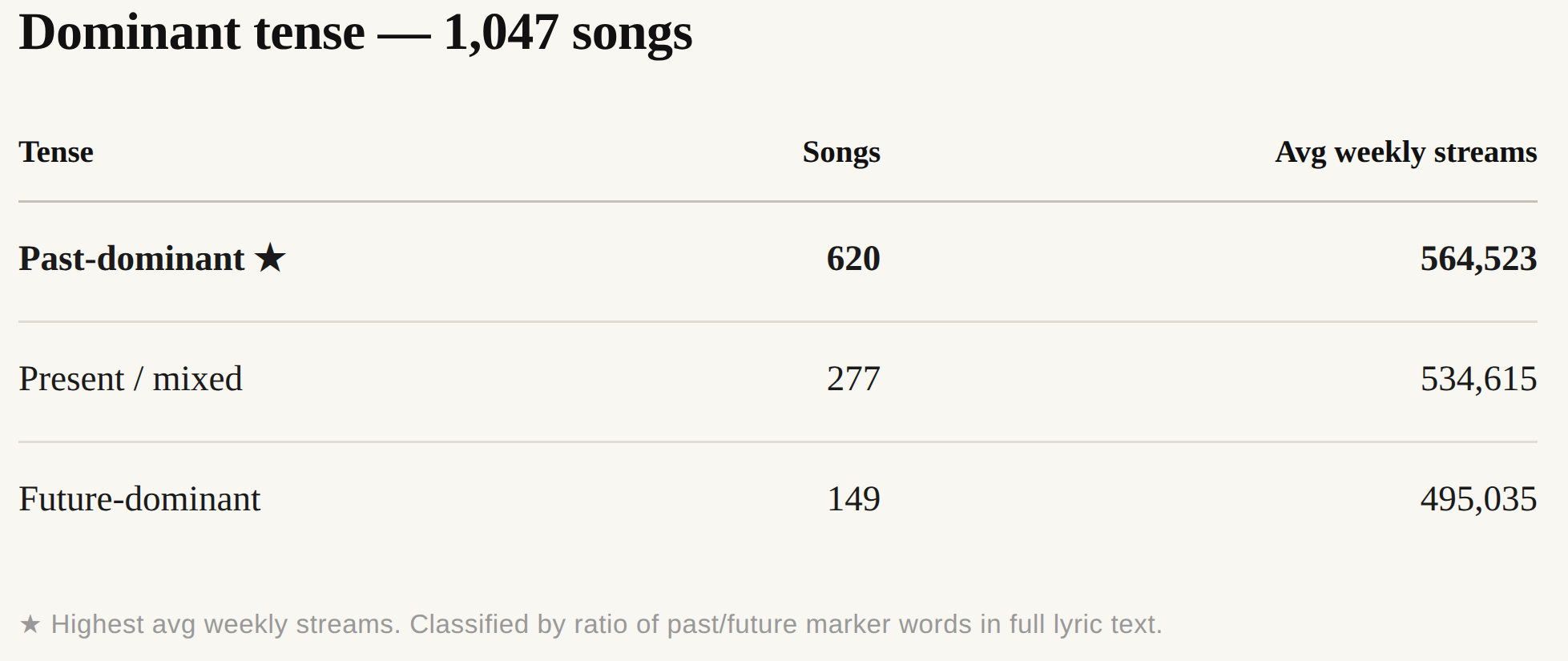
Past tense songs average the highest streams. Does streaming skew toward replay and memory rather than anticipation? These are all popular songs so people clearly stream every tense. But the gradient is consistent and points at something interesting about how music functions in people's lives.
Lyric Sentiment
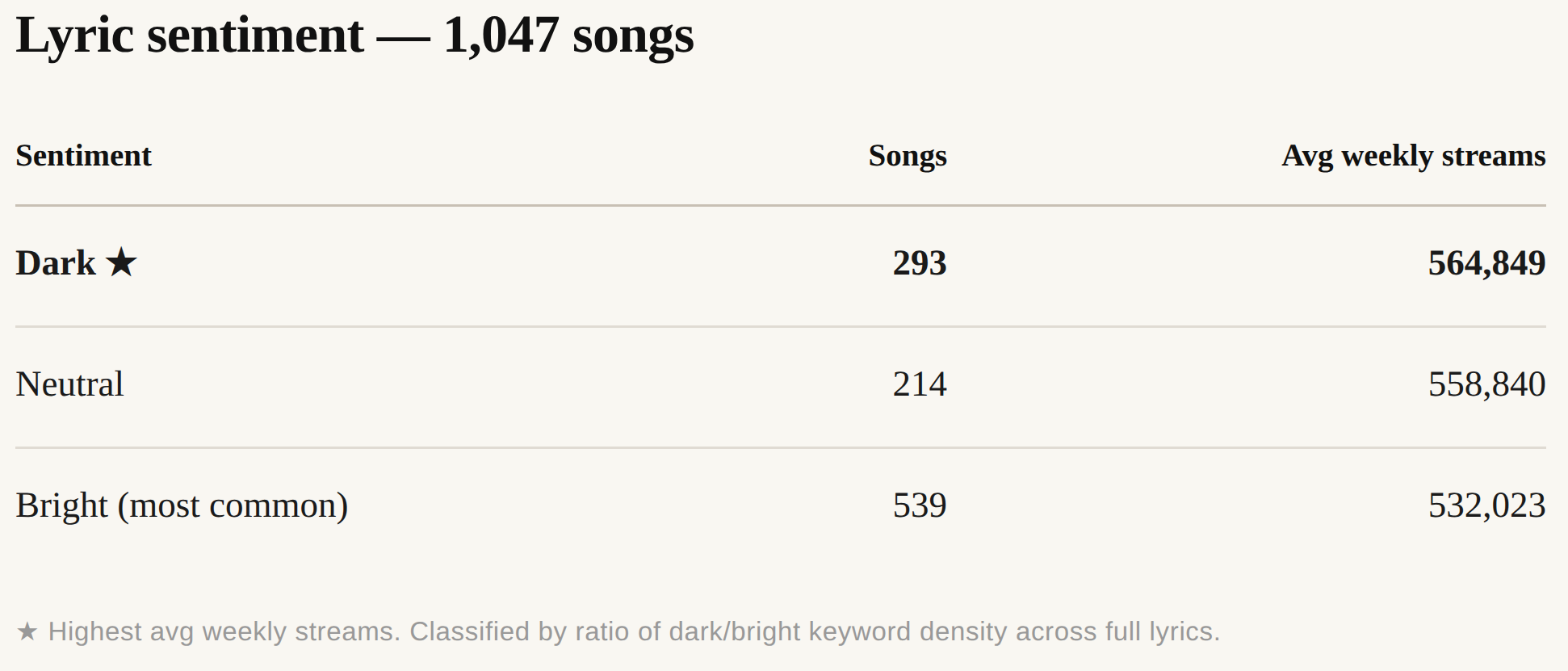
Dark lyrics average more streams than bright ones, despite bright being the most common by far. The data isn't saying bright music fails - every song here is popular. It's just saying the darker leaning songs pull slightly harder when you compare like for like.
Topics / Subject Matter
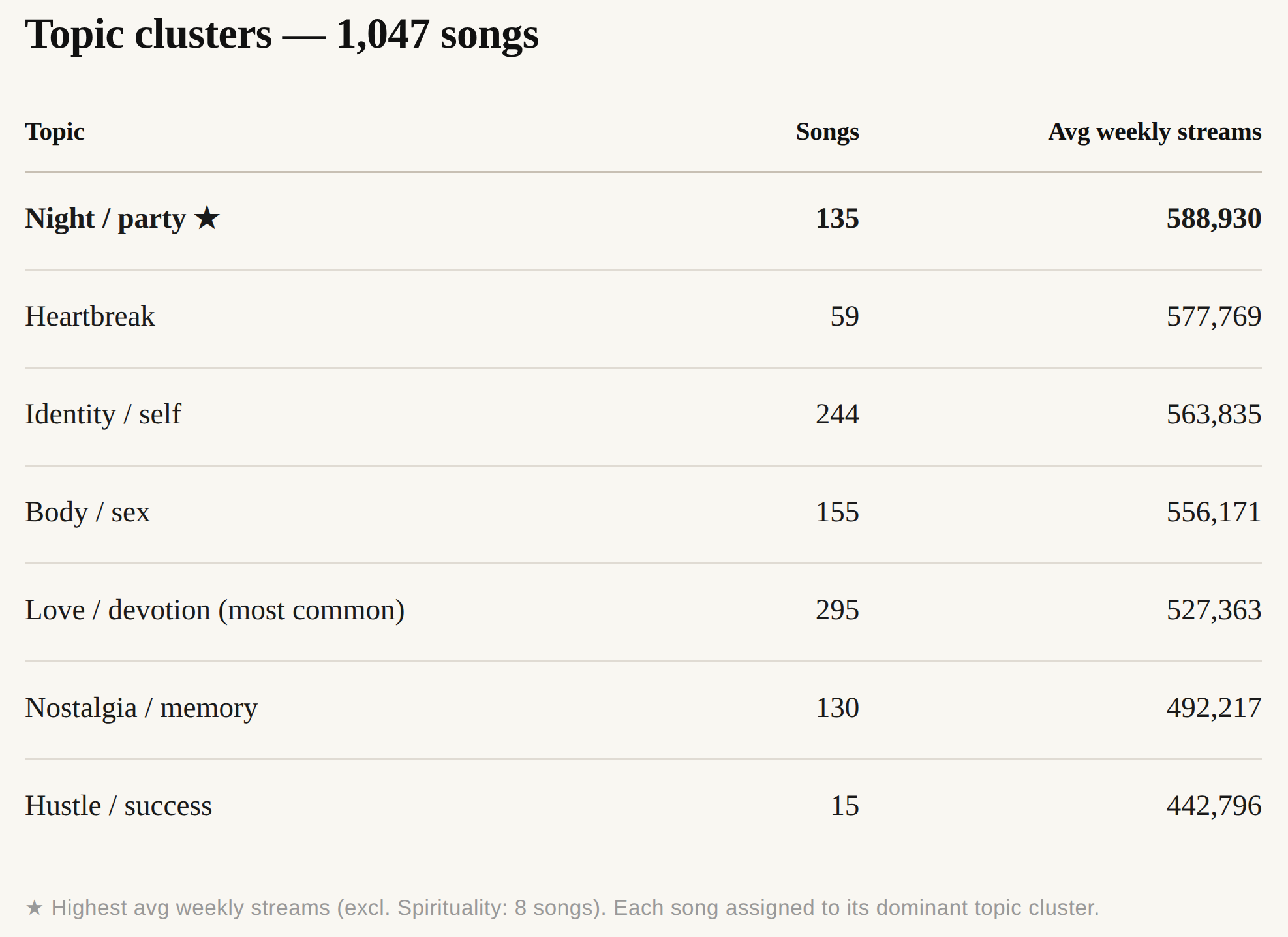
Love and devotion is the most written about topic but sits fifth for average streams. Night and party leads, followed by heartbreak and identity. The question isn't whether love songs work - clearly they do. It's whether the sheer volume of them means any individual love song faces more competition than a song about something less ubiquitous.
Explicit vs clean
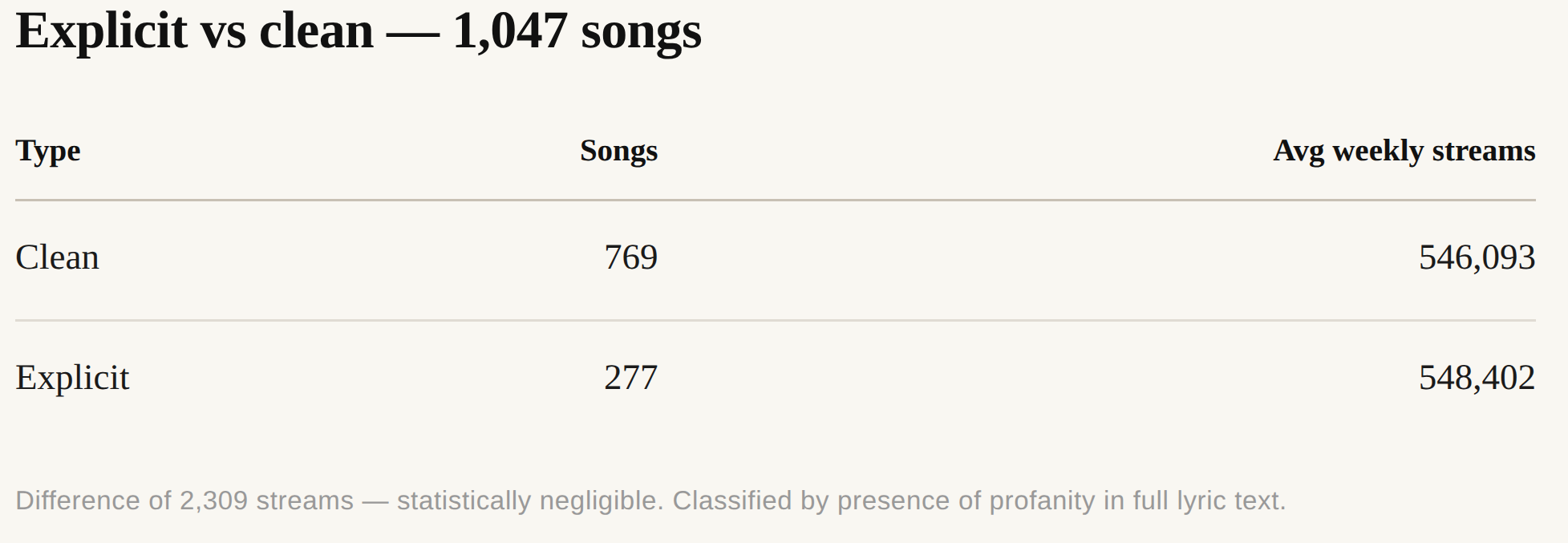
Explicit songs average 548k, clean songs 546k. Essentially identical which is interesting because for decades the music industry managed explicit content as a commercial risk - parental advisories, radio edits, playlist restrictions etc. The streaming data doesn't reflect any of that in audience behaviour. Whether that's the audience evolving, the platforms normalising it or something else isn't clear, but the number is the number.
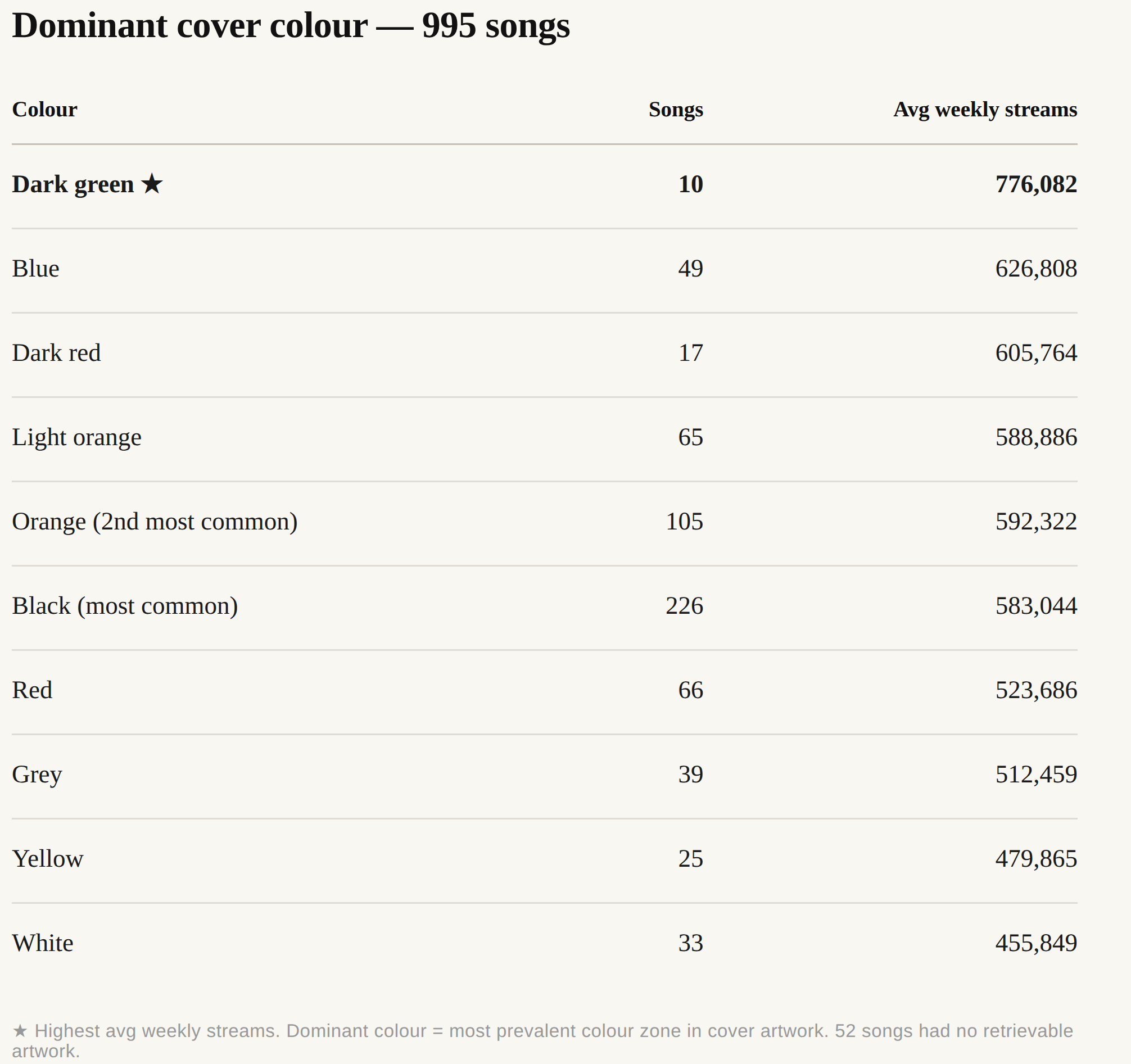
Dominant Cover Colour
Take this one with a pinch of salt but the general pattern across larger groups is that darker, more restrained colours outperform brighter ones.
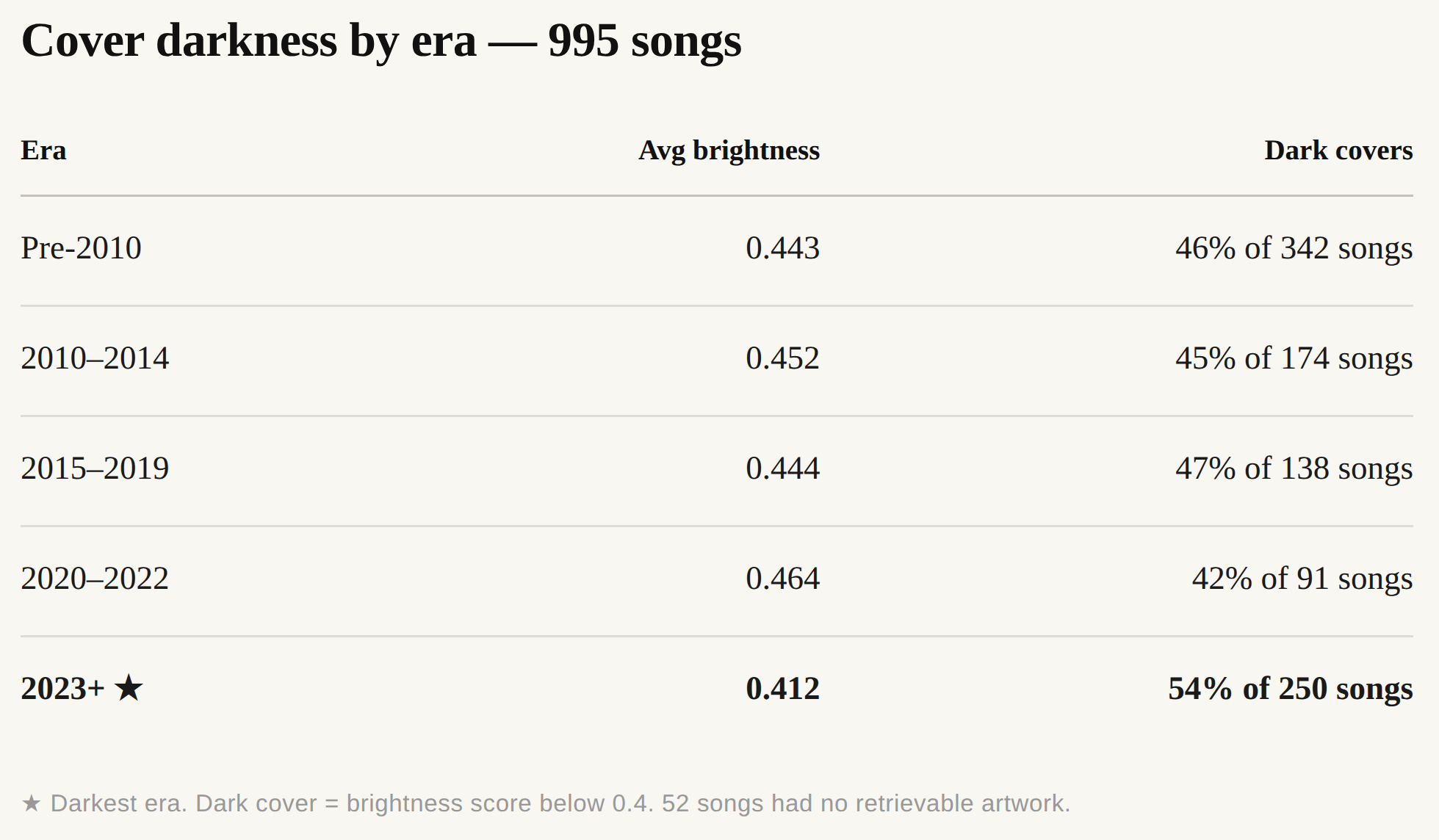
Cover Darkness By Era
Dark covers have increased steadily across every era - whether artists are responding to audience behaviour, platforms are surfacing darker visuals or it's just an aesthetic cycle is hard to know. The direction is consistent though.
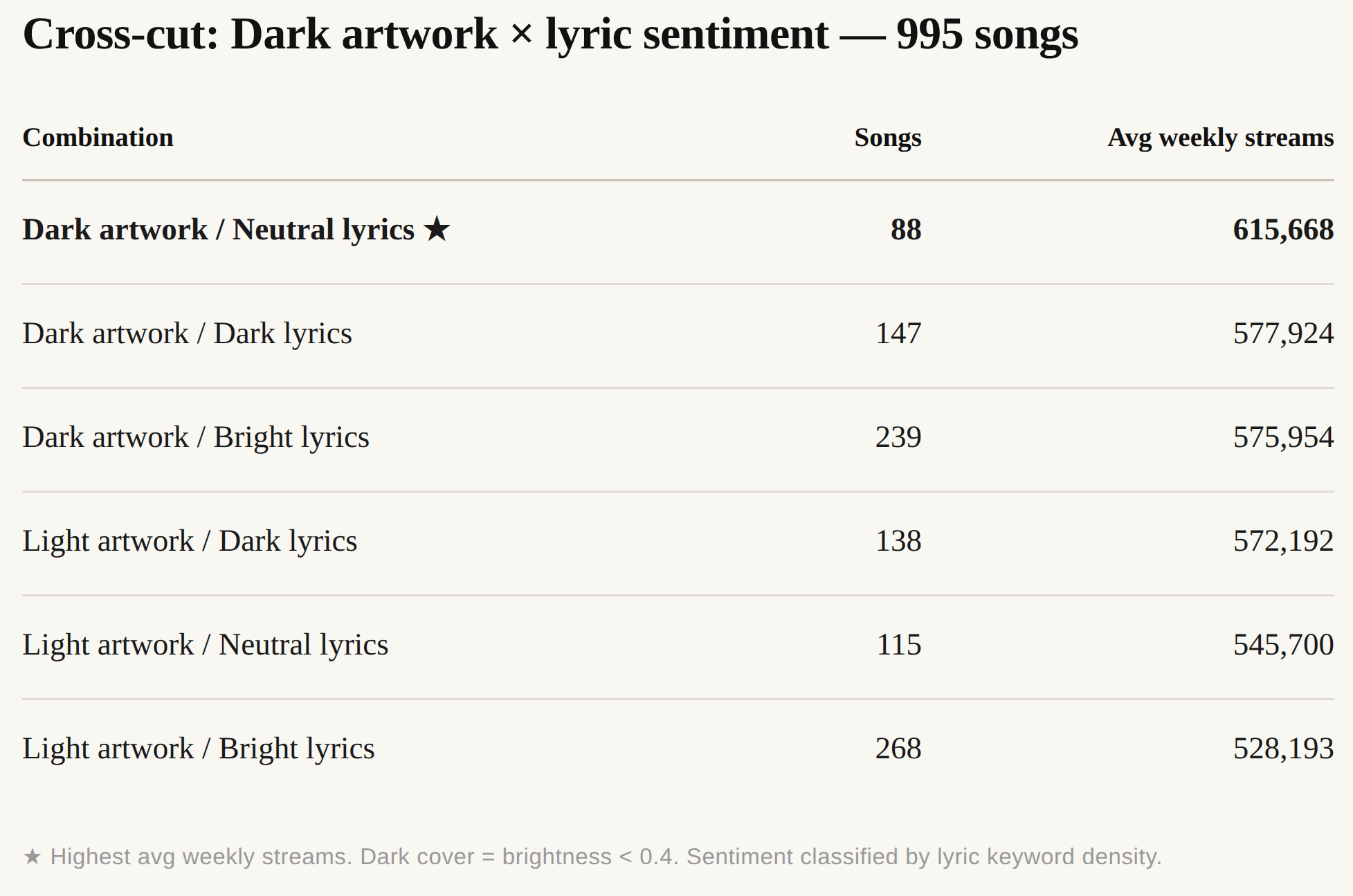
*Bonus point - the highest performing combination is dark artwork paired with neutral lyrics
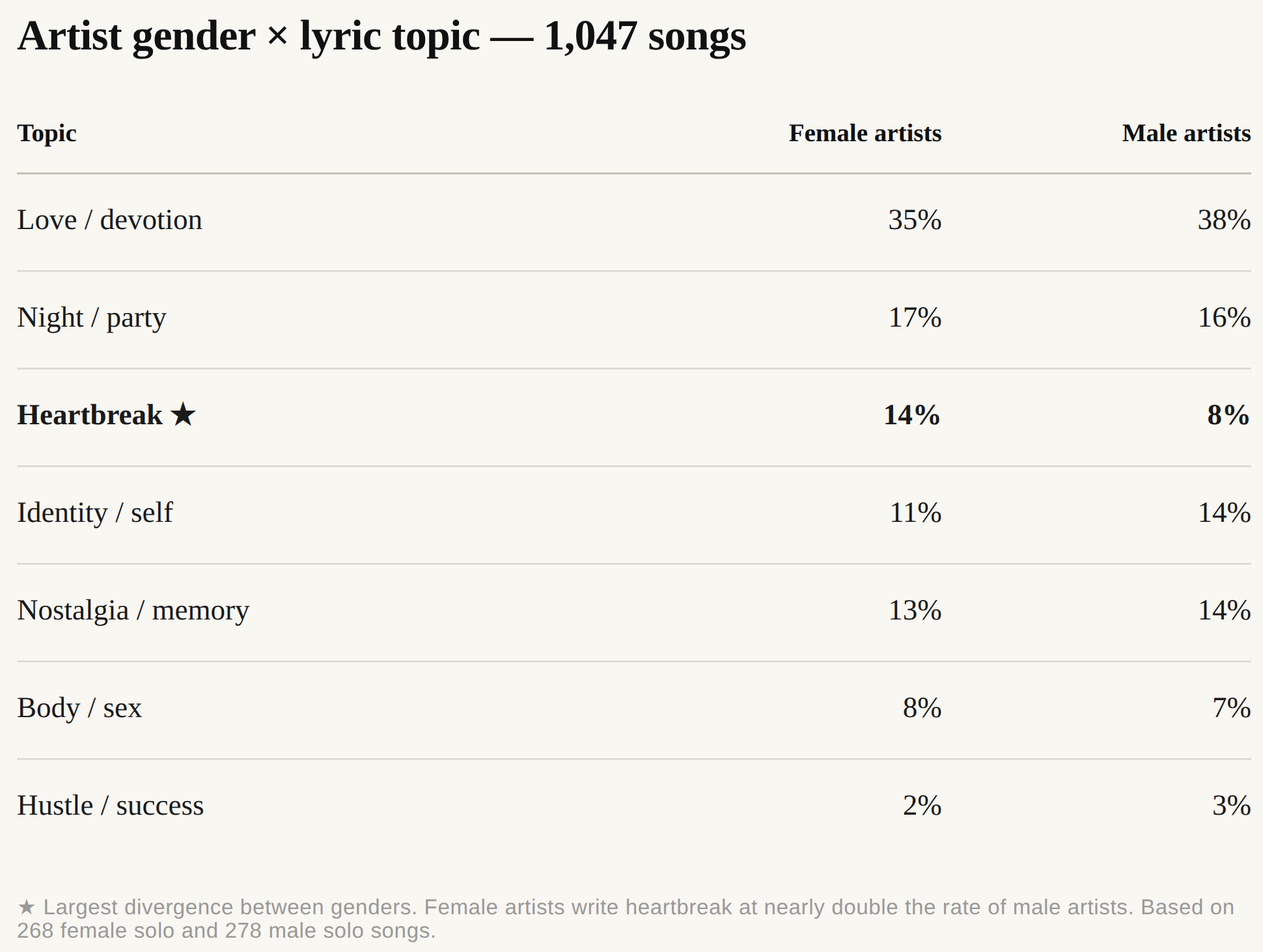
Artist Gender × Lyric Topic
Almost identical distributions across most topics. The one clear gap: female artists write heartbreak at nearly double the rate of male artists….whether that reflects lived experience, audience expectation or commercial calculation is a conversation worth having.
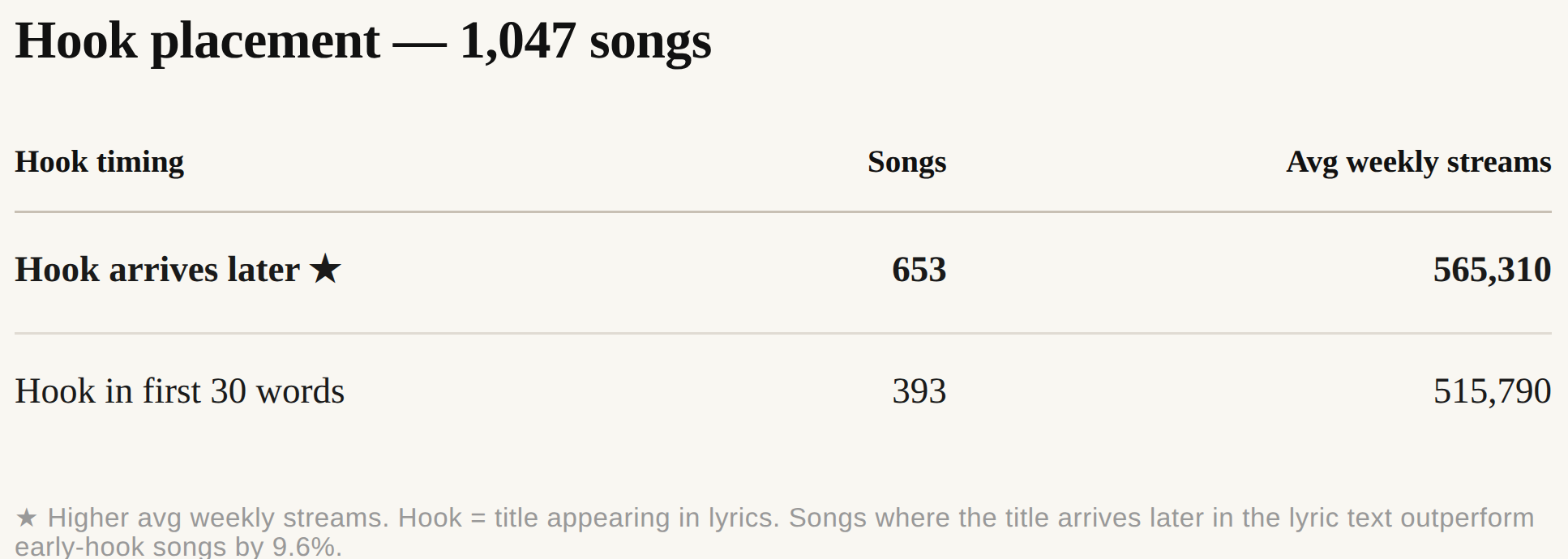
Hook Placement
Songs where the title appears later in the lyrics average almost 10% more streams than songs where it lands in the first 30 words. That slightly runs against the instinct to front load for streaming. Whether delayed hooks cause higher streams or whether they're just a feature of songs with enough gravity to earn the wait is hard to separate. Treat as directional.
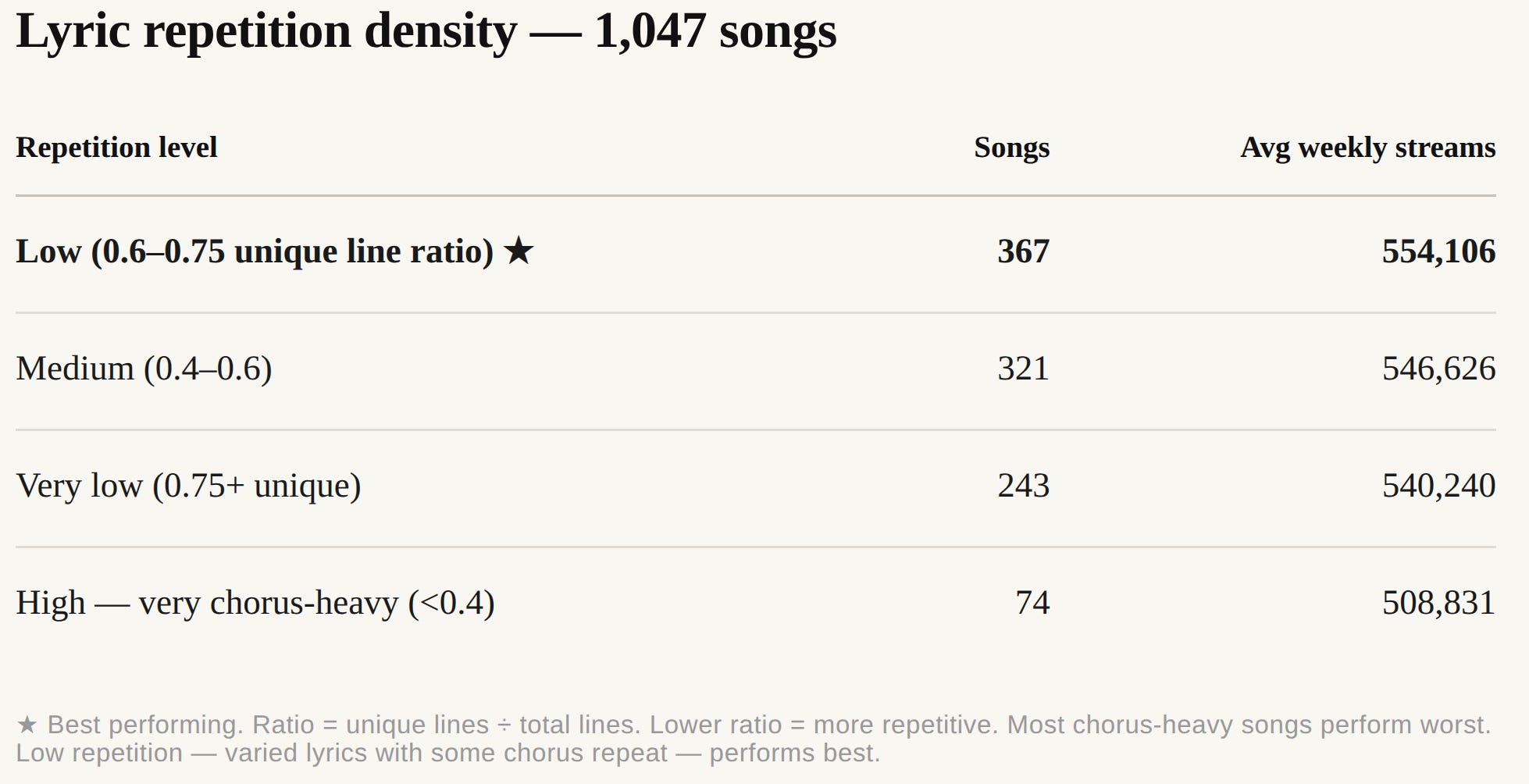
Repetition Density
Songs with more varied lyrics (where each line feels different from the last) average more streams than songs built around heavy repetition. The more you repeat the same lines, the lower the average. That said, some of the biggest songs in the dataset are extremely repetitive and still massive, so this isn't a rule just a pattern worth noticing.
Until next time
Austin
wouldve been good to see data on song length
I wonder what the analysis of darkness says about the UK mindset. Would be interesting to run a like for like with the Billboard chart